
Antonio Poloni Front-end Developer
Front-end adventurer with hands-on experience and skills forged through personal projects and advanced courses. Ready to embark on my first major professional quest.
Projects
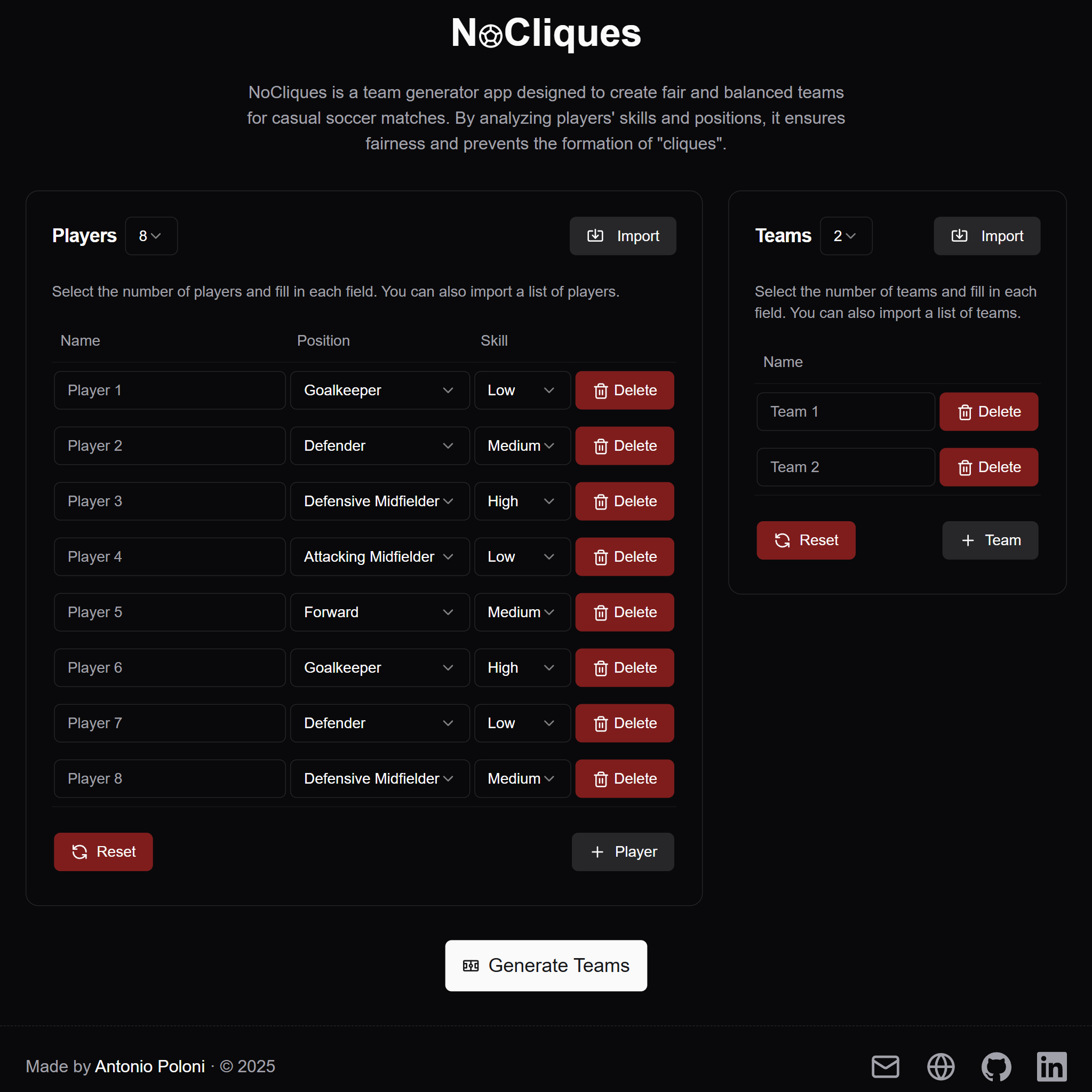
NoCliques
Soccer Team Generator by Skill and Position
NoCliques is a team generator app designed to create fair and balanced teams for casual soccer matches. By analyzing players' skills and positions, it ensures fairness and prevents the formation of "cliques".

São João Frango Assado
Food Ordering System
São João Frango Assado is a web-based food ordering system developed to streamline the process of selecting, customizing, and purchasing homemade meals. The project offers an intuitive interface for customers and a robust order management experience for the business.
Developer motto
Each project is a quest completed. Each course, a new skill unlocked. My evolution as a development adventurer never stops.
Courses
Web Development
Federal Institute of Rio Grande do Sul
Built a solid foundation in web development by learning HTML, CSS, JavaScript, and core programming logic. Developed structured web pages, responsive layouts, and interactive features using form validation and event handling. Explored database fundamentals, data modeling, and system design concepts. Applied end-to-end knowledge through practical exercises, focusing on building maintainable, well-structured web applications.
React & Next.js Learning Path
Frontend Masters
Built a comprehensive foundation in modern React development by completing the official React & Next.js learning path. Learned core React principles, component architecture, hooks, and state management while building real-world UI features. Explored advanced rendering patterns, React Server Components, and performance optimization. Expanded knowledge into full-stack concepts with Next.js, modern tooling, routing, and type safety workflows. Practiced scalable React app design and best practices used in production-level projects.
React Performance, v2
Steve Kinney
Built high-performance React applications by mastering rendering behavior, memoization, and advanced performance strategies. Identified and diagnosed bottlenecks using React DevTools and Profiler, optimized rendering with memoization and component structuring, and applied transitions and deferred values to keep apps responsive. Explored React Fiber internals to understand scheduling and prioritized updates, balanced state to avoid costly re-renders, and leveraged practical performance patterns to build fast, scalable user interfaces.
State Management at Scale in React & Next.js
David Khourshid
Learned scalable state management patterns for React and Next.js to build maintainable applications. Explored common state anti-patterns and refactored them using clear, predictable patterns with reducers, finite states, and event-driven logic. Practiced organizing and optimizing complex state, managing form data, syncing with external stores, and improving app clarity and team collaboration. Applied modern techniques for server and URL state, and used flexible tools like useSyncExternalStore and third-party stores to handle evolving project needs
TypeScript: From First Steps to Professional
Anjana Vakil
Learned how to transition from JavaScript to TypeScript and apply static typing across real projects. Added type annotations, interfaces, unions, and generics to improve code safety and predictability. Configured the TypeScript compiler and tsconfig for scalable setups and practiced strong typing with real examples. Explored workflows for type checking, project conversion, and end-to-end type safety to write cleaner, more maintainable frontend code
Enterprise UI Development: Testing & Code Quality
Steve Kinney
Built scalable enterprise UI applications with a strong focus on testing and code quality. Implemented unit and component tests using Vitest, enforced accessibility standards with Axe, and applied mocking strategies for reliable test coverage. Set up continuous integration with GitHub Actions and standardized code quality using ESLint, Husky, and lint-staged to support long-term maintainability and team scalability.
React and TypeScript, v3
Steve Kinney
Built server-first React apps with TypeScript using actions, streaming, ergonomic Server Components, and scalable typing. Applied Suspense, action-based mutations, and optimistic UI patterns to deliver fast, resilient experiences. Completed an end-to-end, strongly-typed feature with accessible UI and a clear testing strategy.
Next.js Fundamentals, v4
Scott Moss
Mastered building advanced Next.js apps, including React Server Components, Server Actions, and both static and dynamic routing. Implemented features like authentication, caching with dynamicIO, and edge functions. Gained hands-on experience deploying Next.js apps to Vercel, showcasing professional-level skills in modern web development.
Intermediate React, v6
Brian Holt
Mastered React 19 by building high-performance apps with React Server Components, both with and without Next.js. Gained experience with static site generation, server-side rendering, and optimizing performance using transitions and deferred values. Developed the skills and confidence to lead complex React projects.
Professional Learning Path
Frontend Masters
I completed a comprehensive learning path covering advanced JavaScript, React, web performance, modern CSS, deployment strategies, TypeScript, and functional programming. This journey gave me practical experience and in-depth skills needed to excel as a professional web developer and prepared me for senior-level roles.
Functional JavaScript First Steps, v2
Anjana Vakil
I learned functional programming fundamentals in JavaScript, including pure functions, higher-order functions, and functional composition. I practiced writing reliable code by avoiding mutations, and explored the differences between iterative and recursive solutions. This experience helped me write more predictable and maintainable JavaScript applications.
Testing Fundamentals
Steve Kinney
I learned the fundamentals of testing and Test-Driven Development, writing automated tests for DOM elements and user interactions. I gained experience using mocks and spies to test complex code, and practiced writing both unit and integration tests with common testing tools. These skills improved my ability to ship reliable, maintainable code.
TypeScript 5+ Fundamentals, v4
Mike North
I learned key TypeScript features like variable typing, function signatures, union and intersection types, type aliases, and generics. I also gained experience transitioning JavaScript codebases to TypeScript, which improved code reliability and maintainability. These skills help me write more robust, scalable applications.
Full Stack for Front-End Engineers, v3
Jem Young
I gained a solid understanding of full-stack engineering by setting up servers, deploying web apps, and managing networking and security. I worked with the command line, set up CI/CD pipelines, managed databases, and built containerized applications. This hands-on experience gave me the confidence and skills to build, deploy, and manage complete web applications from scratch.
Professional CSS: Build a Website from Scratch
Kevin Powell
During the course, I learned how to create complex layouts using CSS Grid and Flexbox, implemented custom animations, and automated project deployment with GitHub Actions. The hands-on projects helped me better understand how to organize CSS for large applications and improve the visual performance of websites.
Web Performance Fundamentals
Todd Gardner
During this course, I learned how to analyze and optimize website performance using real-world tools like Lighthouse, WebPageTest, and Real User Monitoring. I developed a strong understanding of Core Web Vitals—including LCP, CLS, and INP—and practiced techniques to reduce load times, prevent layout shifts, and improve user interactions. Through hands-on projects, I applied various strategies for diagnosing and fixing performance bottlenecks, resulting in noticeably faster and more responsive web pages. This experience gave me the confidence to measure, interpret, and enhance performance on any web project I work on.
Vanilla JS: You Might Not Need a Framework
Maximiliano Firtman
During this course, I deepened my understanding of building web applications using pure JavaScript, without relying on external libraries or frameworks. I learned how to interact with the DOM directly, manipulate elements, and handle user events efficiently. Through the "Coffee Masters" project, I explored more advanced concepts such as SPA routing, web components, shadow DOM, and reactive programming with proxies. This hands-on experience improved both my confidence and skills in creating responsive, maintainable apps using only the core features of the JavaScript language.
Complete Intro to React, v9
Brian Holt
During this course, I gained hands-on experience building real-world applications using modern React (versions 18 and 19). I developed component-based UIs with JSX, implemented hooks and effects, and worked with advanced concepts like portals and dynamic event handling. I also explored powerful tools in the React ecosystem, such as TanStack Router for routing and TanStack Query for data fetching, along with Vite for fast development, and ESLint and Prettier for code quality. Throughout the projects, I learned essential testing practices using Playwright, including writing unit tests and mocks. Upgrading my app to React 19, I was able to experiment with new features like form actions, suspense, and performance enhancements from the React Compiler, further deepening my understanding of modern React development.
Deep JavaScript Foundations, v3
Kyle Simpson
During this course, I developed a much deeper understanding of JavaScript’s core concepts and inner workings. I learned how JavaScript handles different types, type coercion, and the differences between equality operators (== vs ===). I gained hands-on experience with lexical scope and closures, and explored object-oriented programming in JavaScript, including how this works, prototypes, and ES6 classes. Working through real code examples helped me solidify these foundational skills, making my JavaScript code more robust and maintainable.
JavaScript: The Hard Parts, v2
Will Sentance
During this course, I gained a deeper understanding of how JavaScript works behind the scenes, which has made me a more effective and adaptable developer. I strengthened my knowledge of callbacks and higher-order functions, practiced building and using closures, and worked through hands-on challenges involving asynchronous JavaScript. I also explored object-oriented programming patterns in JavaScript, which helped me write more organized and reusable code. These experiences have given me new mental models for tackling complex problems and improved my overall confidence when working with JavaScript in real-world scenarios.
Beginner Learning Path
Frontend Masters
Completed a beginner learning path covering web development fundamentals, JavaScript, and modern CSS layout techniques. Gained practical skills to build responsive websites and a solid foundation for a career as a professional web developer.
Website Accessibility, v3
Jon Kuperman
During this course, I learned how to make web content accessible to all users by applying best practices in semantic HTML and alt text, ensuring compatibility with screen readers. I gained hands-on experience creating accessible navigation using proper focus states, managing tab order, and implementing advanced techniques such as tab trapping. I also learned how to identify and fix color contrast issues, and how to use ARIA labels and roles to make complex user interfaces accessible. These skills have enabled me to create websites that are more inclusive and provide a better experience for everyone.
JavaScript: From First Steps to Professional
Anjana Vakil
During this course, I built a solid foundation in JavaScript by working through a variety of hands-on projects. I learned how to make websites dynamic by modifying web pages in real time, writing reusable functions, and handling user-driven events. I also practiced using conditionals to control application logic and worked with APIs to fetch and display data. This experience gave me the essential skills and confidence to continue growing as a JavaScript developer and to start building interactive web applications on my own.
CSS Foundations
Emma Bostian
During this course, I built a strong foundation in modern CSS by learning core concepts and terminology, as well as practical layout techniques using Flexbox and CSS Grid. I completed hands-on challenges that involved styling interactive buttons, designing landing pages, and creating responsive navigation menus for mobile devices. By applying these skills in real projects, I gained the confidence to build professional, responsive websites and improved my ability to solve layout and design challenges in web development.
Getting Started with JavaScript, v2
Kyle Simpson
During this course, I was introduced to the fundamentals of programming with JavaScript, including variables, loops, functions, and basic operations. I explored JavaScript’s core pillars in depth—learning how types and coercion work for value comparison and conversion, gaining a solid understanding of scope and closures to manage variable accessibility, and examining how the this keyword and prototype system provide dynamic context in JavaScript. These foundational lessons gave me the confidence to start building simple programs and a clear path for advancing my JavaScript skills.
Getting Started with CSS, v2
Jen Kramer
During this course, I learned how to build a modern and visually appealing portfolio website using CSS and semantic HTML. I gained hands-on experience designing responsive layouts with media queries, customizing styles with CSS custom properties, and creating intuitive navigation. I also implemented both light and dark themes to enhance user experience. By the end of the course, I successfully deployed my portfolio to GitHub Pages, allowing me to showcase my projects and skills to a global audience.
Complete Intro to Web Dev, v3
Brian Holt
During this course, I built a strong foundation in modern web development by learning how to create websites from scratch using HTML, CSS, and JavaScript. Through hands-on coding exercises, I gained practical experience in structuring web pages, applying styles for visual design, and adding interactivity with JavaScript. As a final project, I developed a Wordle clone, which allowed me to combine all the skills I learned and build a complete, real-world application. This experience gave me the confidence and essential skills needed to pursue a career as a professional web developer.
JavaScript Algorithms and Data Structures
freeCodeCamp
During this certification, I strengthened my understanding of JavaScript fundamentals such as variables, arrays, objects, loops, and functions. I learned how to manipulate the DOM to create interactive web pages and explored both Object Oriented Programming (OOP) and Functional Programming paradigms. Through hands-on projects, I developed algorithmic thinking and practiced solving real-world problems. I also gained experience working with browser local storage and fetching data from APIs, giving me a solid foundation for building dynamic and efficient web applications.
Responsive Web Design
freeCodeCamp
During this certification, I gained practical experience using HTML and CSS to build modern, responsive web pages. I started by developing a simple cat photo app to learn the fundamentals of HTML structure and CSS styling. As I progressed, I explored advanced CSS concepts like variables by building a penguin project, and incorporated accessibility best practices while creating an interactive quiz site. I also learned to make layouts that adapt to different screen sizes, building a photo gallery with Flexbox and a magazine article layout with CSS Grid. These projects equipped me with the essential skills to create accessible, visually appealing, and responsive websites.
Web Development Bootcamp
Frontend Masters
During this course, I received a comprehensive introduction to HTML, CSS, and JavaScript, learning how these core technologies work together to build modern websites. Through hands-on projects, I practiced structuring web content with HTML, designing and styling pages with CSS, and adding interactivity using JavaScript. These experiences not only gave me a strong foundation in web development but also allowed me to create and showcase projects that demonstrate my new skills.